
Hopkins County Court Records After a Jail Arrest
After a Hopkins County arrest, the first public record is often the sheriff-linked Synergistic Software jail roster. That roster is useful, but it is not the final court record. It shows the booking side of the case: current custody status, arrest date, arresting or holding agency, days in jail, total bond, warrant number, statute, charge description, misdemeanor or felony indicator, and per-charge bond amount when those fields are available. The formal case develops through the courts when the District Attorney, County Attorney, or other prosecuting authority files or changes charges.
The local court path depends on the charge level. Felony matters generally move through district court, with prosecution by the 8th Judicial District Attorney. Misdemeanor matters can route through County Court at Law or county-level prosecution. The County Court at Law page says that court hears criminal misdemeanors and Class C appeals, along with civil, family, probate, guardianship, and mental-health matters. It also states that court records are maintained by both the District Clerk and County Clerk, which matters when a person is trying to match a jail arrest to a filed court case.
For custody and booking details, use jail inmate records. For booking photos and photo availability, use jail mugshots. Court records after a jail arrest answer a different question: what charge was filed, what court is handling it, what setting appears on the docket, whether a charge is pending or dismissed, and whether the case ended in conviction, deferred disposition, or another court outcome.
How to Find Hopkins County Court Records After an Arrest
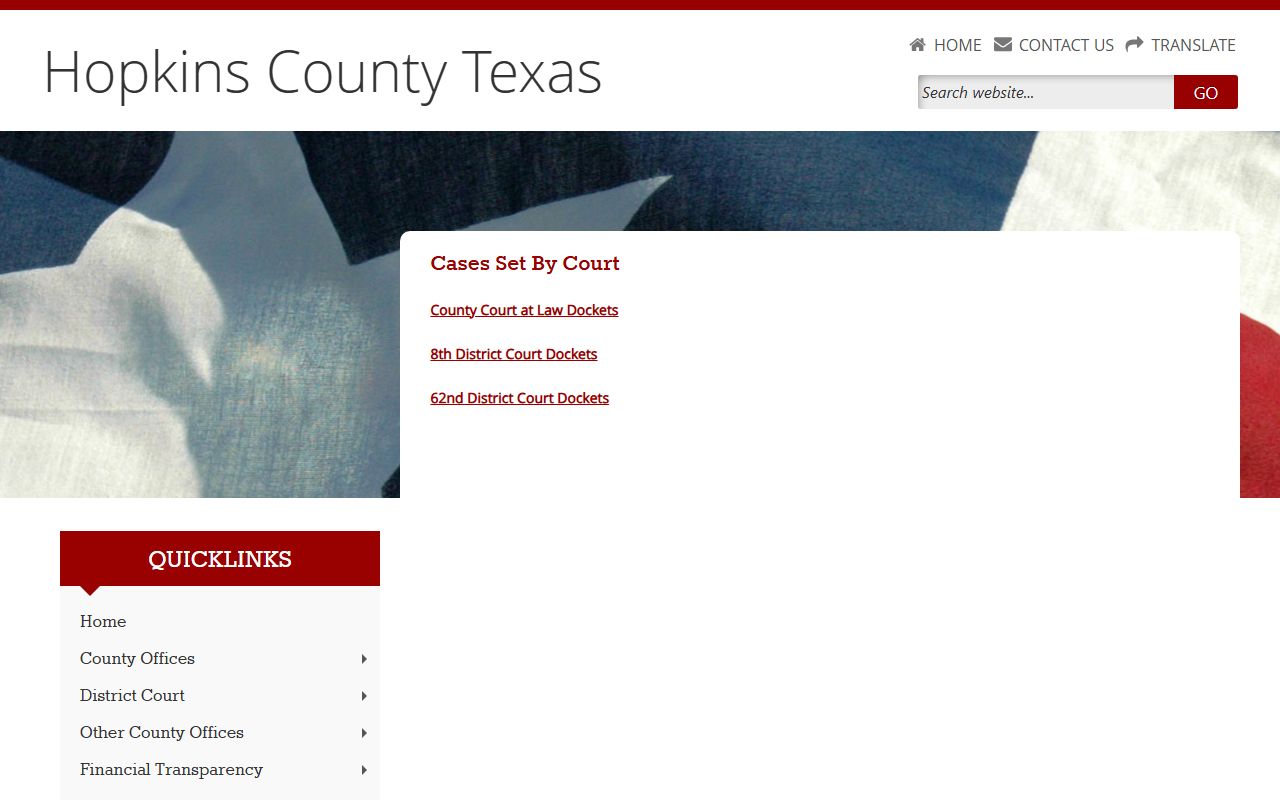
Begin with the jail roster because it supplies the arrest date, agency, statute, charge language, bond amount, and any visible warrant number. Then use the court lookup channels for filed-case information. Hopkins County publishes a Cases Set By Court page that links the County Court at Law, 8th District Court, and 62nd District Court docket resources. The EasyDocs county docket and district docket links are the practical public starting points for settings after arrest.
- Search the jail roster first and write down the full name, arrest date, arresting agency, statute, charge description, bond amount, and warrant number if shown.
- Open the Hopkins County Cases Set By Court page and choose the county or district docket that fits the charge level.
- Search by defendant name when the docket allows it, or use the court, case type, and sort fields to scan criminal settings.
- Open or review the docket row for the case number, setting date, setting time, party name, case type, setting type, offense, and bond note.
- If the case does not appear online, contact the District Clerk for district criminal cases or the County Clerk for county court records.
The official docket index is shown in the captured source image below. It is important because the jail roster can update before the court docket is ready, especially when the arrest is recent or the prosecutor has not yet filed a charging instrument.
Statewide and federal systems serve different purposes. The Texas Department of Criminal Justice search is for sentenced state-prison custody after a person leaves the county jail. BOP and ICE tools are for federal prison or immigration detention. VINELink is useful for custody notifications and release or transfer alerts, but it is not a substitute for a clerk's court record.
EasyDocs Docket Search Fields for Court Records After Arrest
Hopkins County's EasyDocs district docket interface was captured with three main search or sorting controls. The county docket sample text also showed case number, setting date, setting time, party or defendant, case type, setting type such as pre-trial, offense text, and bond notes such as P/R bond. Older county docket PDFs contained even more detail, including attorney or bondsman, action, date of offense, reset notes, and driver's license class in some entries.
| Field Label | Type | Required | Options / Format Notes |
|---|---|---|---|
| Court | Dropdown | No or unspecified | *All, County Court at Law, 62nd District, 8th District. |
| Case Type | Dropdown | No or unspecified | *All, Criminal, Civil, Probate. |
| Sort Order | Dropdown | No or unspecified | Date/Time, Plaintiff/Petitioner, Defendant. |
Those fields mean a user may need to search in more than one way. A felony arrest may appear in district court. A misdemeanor arrest may appear in County Court at Law. A very recent arrest may show on the jail roster before a docket setting appears online.
How Charges Get Filed After an Arrest: Complaint, Information, and Indictment
Booking creates a jail record. A charging document creates the court case or supports court action after the arrest. In Hopkins County, the District Attorney's office is the key prosecution office for felony-level cases in the 8th Judicial District. The County Attorney office provides misdemeanor prosecution context. A complaint can support the initial accusation and magistrate process, an information is a prosecutor-filed formal charge, and an indictment is a grand jury charging instrument, most often associated with felony prosecution.
| Document | Usually Filed or Initiated By | Common Use After Arrest | What to Check |
|---|---|---|---|
| Complaint | Officer, prosecutor, or complainant process | Initial allegation, magistrate action, or support for a misdemeanor or felony accusation | Charge description, probable-cause basis, warrant or magistrate connection |
| Information | Prosecutor | Formal prosecutor-filed charge, often used without a grand jury indictment where allowed | Filed offense, level, amendments, dismissal, plea, or judgment |
| Indictment | Grand jury | Felony charging instrument after grand jury action | Case number, count list, offense date, court assignment, arraignment or later settings |
Do not assume the wording on the jail roster will match the filed court charge word for word. The prosecutor may file a different offense, add counts, reduce the charge, decline a count, or present a felony matter to a grand jury.
Charge Status in Court Records After a Hopkins County Arrest
Charge status can change as a case moves from booking to docket to judgment. The roster may show a charge and bond amount on the day of arrest, while the court record later shows that the charge was amended, reduced, dismissed, deferred, or resolved by plea or trial. Hopkins County docket and clerk records are the better source for the current court status because they track procedural action after the booking entry.
| Status | What It Means | Why It Matters |
|---|---|---|
| Pending | The charge is filed or active and has not reached a final court outcome. | Future settings, bond conditions, attorney appearances, or plea negotiations may still occur. |
| Amended | The prosecutor or court record reflects a changed charge, count, wording, or filing detail. | The filed court record may differ from the original jail roster charge. |
| Reduced | A lesser charge is filed, accepted, or reflected in the case outcome. | The final court record can be less severe than the booking charge. |
| Dismissed | The charge is not pursued in that case or is terminated by court action. | A dismissal is not the same thing as an automatic expunction or disappearance from every record. |
| Convicted | The defendant was adjudicated guilty through plea, verdict, or other court judgment. | This is a final case outcome, not merely an arrest or accusation. |
| Deferred | The case has a deferred disposition or deferred adjudication outcome rather than an ordinary conviction at that stage. | It may still appear in court records and has eligibility rules that differ from a dismissal. |
Hopkins County Clerk, District Clerk, and Prosecutor Details
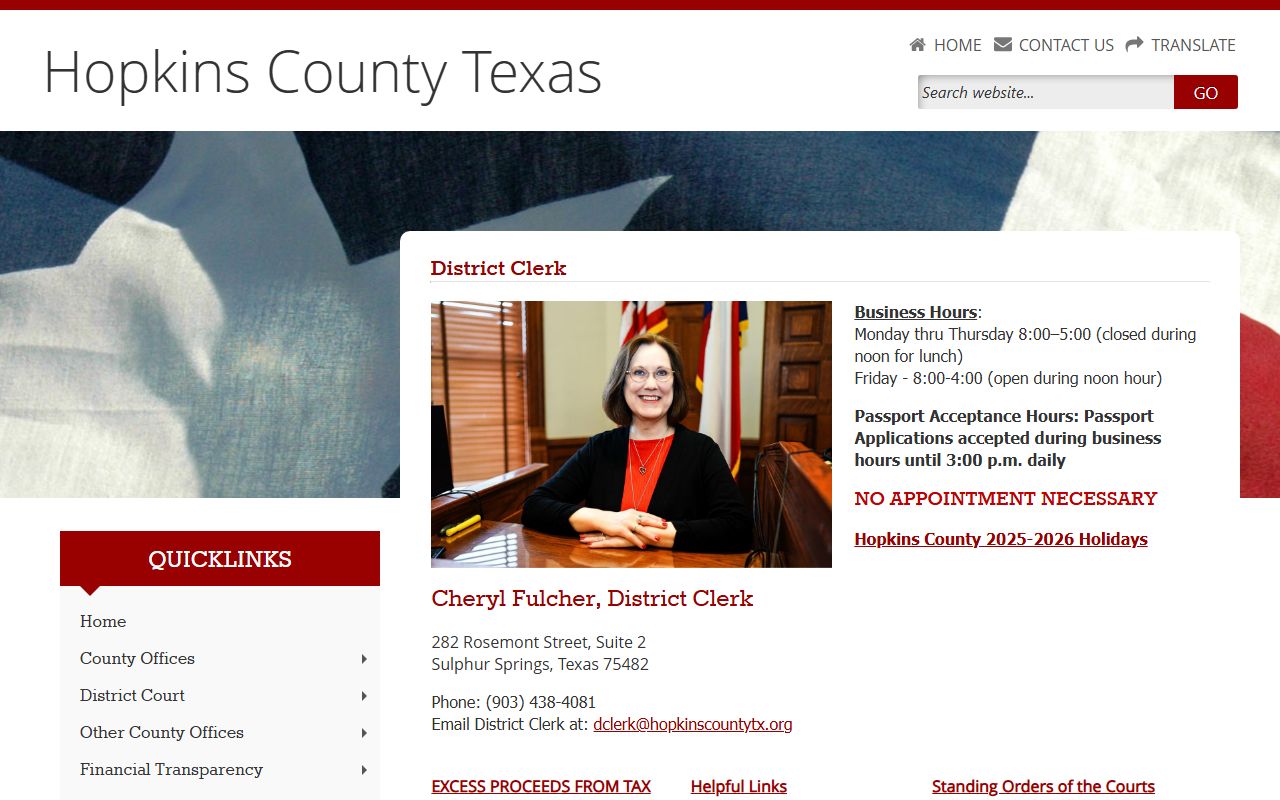
The District Clerk is the main local contact for district criminal case records. The Hopkins County District Clerk page lists Cheryl Fulcher as District Clerk at 282 Rosemont Street, Suite 2, Sulphur Springs, TX 75482. The office phone is (903) 438-4081 and the listed e-mail is dclerk@hopkinscountytx.org. Criminal deputy clerks listed in the research are Tyra Kenemore at (903) 438-4086 and tkenemore@hopkinscountytx.org, and David Gilmore at (903) 438-4084 and dgilmore@hopkinscountytx.org. Published hours are Monday through Thursday 8:00 to 5:00, closed during noon for lunch, and Friday 8:00 to 4:00, open during the noon hour.
The District Clerk source page is shown below with the clerk office and criminal deputy clerk context used for after-arrest court record routing.
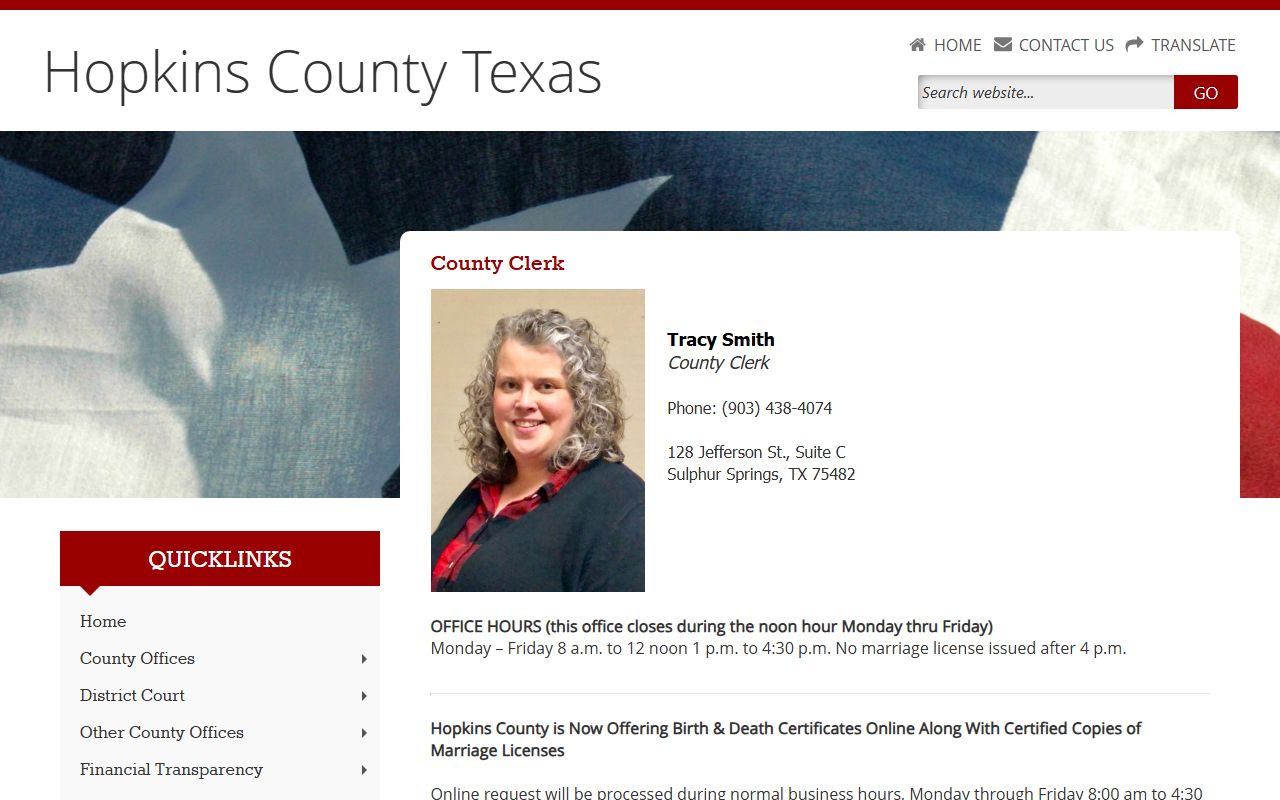
The County Clerk is listed at 128 Jefferson St., Suite C, Sulphur Springs, TX 75482, phone (903) 438-4074. County Court at Law records may involve both the District Clerk and County Clerk, so misdemeanor searchers should not stop after checking only one office.
The County Clerk source page is the local source for county clerk contact and public-record office context.
For prosecution, the District Attorney source page names Will Ramsay as District Attorney for the 8th Judicial District. The office is listed at 282 Rosemont - Suite 1, Sulphur Springs, TX 75482, with phone (903) 885-0641. The DA can explain prosecution-office procedure, but official copies and docket settings usually come from the clerk, not the prosecutor.
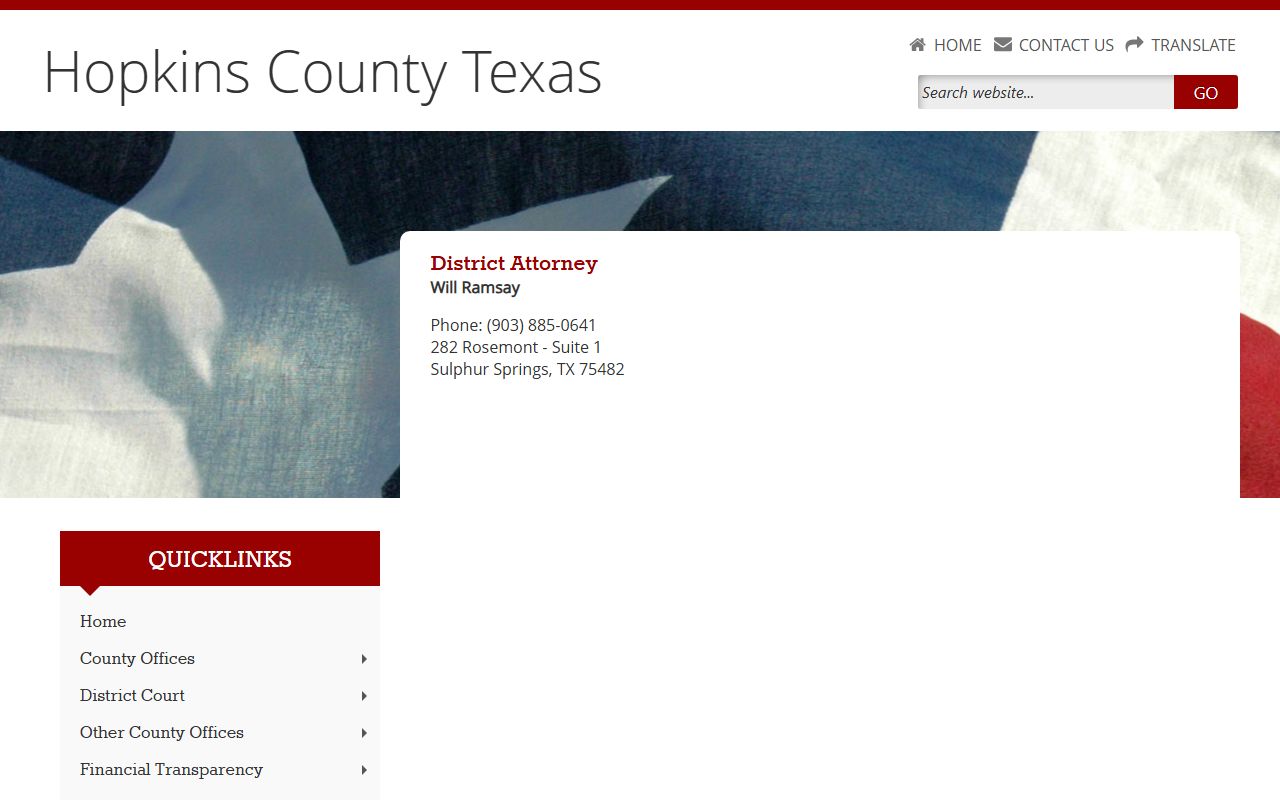
That separation keeps after-arrest research practical: the prosecutor controls charging decisions, but the clerk offices are the usual route for copies, docket entries, and filed-case status.
Bond and Release After an Arrest
Texas bond rules are governed mainly by Code of Criminal Procedure Chapter 17. Hopkins County roster entries display bond in two useful places: Total Bond and per-charge Bond Amount. Research found examples of numeric totals and "NOT SET." A not-set bond usually means the person may need magistrate action, court action, or a hold cleared before ordinary release. Texas Article 15.17 also requires an arrested person to be taken before a magistrate without unnecessary delay and generally within 48 hours.
| Bond Type | How It Works | Hopkins County Lookup Note |
|---|---|---|
| Cash Bond | Money is posted for release and later handled through the court process. | Confirm the exact amount and posting procedure before paying. |
| Surety Bond | A commercial bail-bond company posts a surety bond. | Verify that the bond covers every charge and hold. |
| Personal Bond / PR Bond | Release is based on a promise to appear and any ordered conditions. | County docket samples showed bond notes such as P/R bond. |
| Property Bond | Property is pledged if allowed and accepted under court procedures. | Ask the relevant court or clerk about local acceptance requirements. |
| No-Bond Hold | Custody cannot be cleared just by paying a visible amount. | Outside-agency holds, parole or probation matters, federal issues, immigration detainers, or no-bond charges may block release. |
The sheriff page did not publish a bond counter, accepted payment methods, posting hours, online bond-payment page, or fee table in the visible text captured. The research-backed route is to check the roster first, then call the Hopkins County Sheriff's Office at (903) 438-4040 or contact the appropriate clerk or court for case-specific handling.
Warrants That Lead to an Arrest
No official Hopkins County active warrant search page was located in the county website text captured for this project. The jail roster does expose warrant-related information after a person is booked because the charge table includes a Warrant# column. That is not the same as a searchable active warrant database. It means the warrant number may become visible only after arrest and booking.
For warrant-related questions, use the sheriff phone line at (903) 438-4040 for custody or sheriff questions, the District Clerk for district or felony court warrants, the County Clerk or County Court at Law for county-court criminal matters, and justice or municipal courts for lower-court traffic, Class C, or bench warrant issues. Docket pages can also show missed settings that may lead to capias or bench warrant activity.
Charges vs. Convictions in Court Records After Arrest
A Hopkins County arrest charge is an accusation or custody entry, not proof that the person was convicted. Court records after a jail arrest should be read by stage. The booking entry may show what the person was arrested for. The prosecutor's filing shows what the State chose to pursue. The judgment or final disposition shows whether the case ended in conviction, dismissal, deferred outcome, acquittal, or another result.
| Charge | Conviction | |
|---|---|---|
| Stage | Accusation, filed count, or booking allegation. | Final court outcome after plea, verdict, or judgment. |
| Proof Level | May begin with probable cause or prosecutor filing decision. | Requires the criminal standard applied by the court process. |
| Where It Appears | Jail roster, charging document, docket, complaint, information, or indictment. | Judgment, sentence, final disposition, or clerk record. |
| Meaning | The case is alleged, pending, changed, or still being litigated. | The person has been adjudicated guilty unless the disposition says otherwise. |
| Public Caution | Do not treat a charge as a conviction. | Still verify the exact case number, offense, and final court language. |
Sealed vs. Expunged Arrest Records
Texas public access begins with the Texas Public Information Act, Government Code Chapter 552, but not every record remains publicly available in the same way forever. Texas Code of Criminal Procedure Chapter 55 governs expunction for eligible criminal records. Sealing and nondisclosure concepts are different from expunction, and eligibility depends on the case outcome, timing, offense, and court order. A dismissed charge on a docket does not automatically erase the jail booking record or every third-party copy.
| Sealed / Nondisclosed | Expunged | |
|---|---|---|
| Basic Effect | Public visibility is restricted by court order or statute. | Eligible records are ordered destroyed, returned, or treated as legally removed under the expunction order. |
| Public Search | Often hidden from ordinary public access, with exceptions. | Should not appear as an ordinary public criminal record after proper processing. |
| Government Access | Certain agencies may retain limited access depending on the order and law. | Access is very limited and controlled by the expunction statute and order. |
| Eligibility | Depends on Texas law, offense type, disposition, waiting period, and court order. | Depends on Chapter 55 eligibility, dismissal or acquittal paths, identity issues, or other statutory grounds. |
| Practical Step | Ask the clerk or an attorney about nondisclosure or sealing procedure. | Ask the clerk or an attorney about filing for expunction in the proper court. |
Texas Business & Commerce Code Chapter 109 also matters for certain commercial publishers of criminal-record information and removal or correction requests. It is not a promise that the Hopkins County Sheriff's Office, clerk, or prosecutor will remove an official public record on demand.
Background Check Considerations
Casual public-record searching is different from a regulated background check. Employers, landlords, lenders, insurers, and other regulated users must follow the Fair Credit Reporting Act and any applicable Texas or federal rules. A court docket, jail roster entry, or arrest note should be verified with the originating office before anyone treats it as complete, current, or final.
Important: This website is not a consumer reporting agency and may not be used for FCRA-covered screening decisions.
Restricted Court Records After an Arrest in Hopkins County
Texas public-record law allows access to many government records, but exceptions and confidentiality rules still apply. Juvenile matters, sealed or expunged cases, some mental-health or family-court material, victim information, protected personal identifiers, and active law-enforcement information may be limited or withheld. Hopkins County jail records also redact some fields in public view. The roster research found addresses shown as "REDACTED," and the public roster did not show date of birth, race, age, housing location, medical status, classification, or exact booking time.
When a record is missing from the public docket, the best next step is narrow and specific: provide the person's full name, approximate arrest date, arresting agency, case number if known, and the exact record type requested. Use the sheriff or Texas Public Information Act path for jail records, the District Clerk or County Clerk for court records, and the prosecutor only for prosecution-office procedure.